Can You Climb Arenal Volcano?
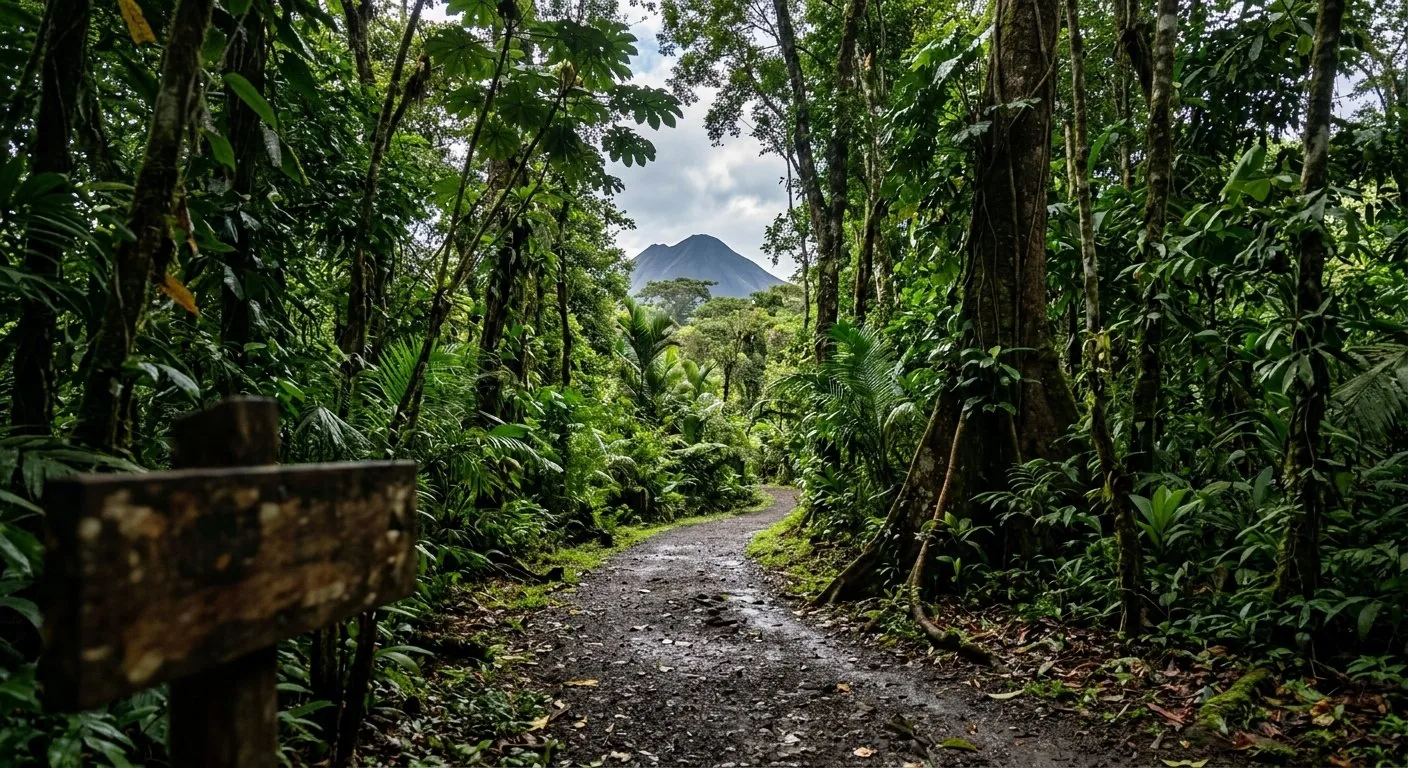
The short version
- There is no legal route to the summit and no public permit process. The restriction is enforced by SINAC, Costa Rica’s national conservation-areas authority.
- The 4 km exclusion zone around the crater dates from 1998 and has not been lifted.
- The widely-repeated claim that “many climbers have died” on Arenal cannot be substantiated. We looked for a count and there is not one. What is documented is the 23 August 2000 pyroclastic flow, which killed a guide and an eight-year-old visitor.
- Cerro Chato, the usual suggested alternative, has been closed to hikers since 2017, with enforcement tightened again in 2025. Guides who offer it are offering something illegal.
- What you can walk: Las Coladas (about 2 km, the 1992 flow), Los Tucanes (about 3 km), El Ceibo (about 1.9 km) inside the national park, plus around 7 km of trails in the privately-run Arenal 1968 reserve.
- The summit is 1,633 m. You will get nowhere near it, and the elevation gain on the lava-field walks is minimal.
Why can’t you climb Arenal Volcano?
Because the crater sits inside a 4 km exclusion zone established in 1998, after explosions on 5 May of that year produced 23 pyroclastic flows and forced the evacuation of more than 400 residents. The zone restricts access to park officials, monitoring staff and emergency personnel. It has never been lifted, and it was not lifted when the volcano stopped erupting in 2010.
The physical case for the restriction is straightforward even now that the mountain is quiet. The upper cone is loose tephra on a steep slope, rebuilt repeatedly over 42 years of eruption and never consolidated. Avalanches release off it without any eruptive trigger at all. And the hazard that killed people here was pyroclastic flow — which moves at up to 80 km/h, gives no useful warning, and cannot be outrun by anyone at any fitness level.
Have people died trying to climb Arenal?
This is where the internet gets sloppy, so here is what we could and could not verify.
What is documented: on 23 August 2000, the strongest eruption since 1968 sent pyroclastic flows 2.3 km from the crater. Guide Ignacio Protti died that night. An eight-year-old American girl died on 6 September of burns sustained in the same flow. A third person was severely burned and survived. Separately, on 26 August 2000, a Cessna 208B struck the slope about 200 m below the summit in cloud, killing all ten people aboard — that was an aircraft accident, not a climbing one, though it often gets absorbed into the same story.
What is not documented: the claim, repeated across a lot of tourism writing, that “many climbers have been killed or maimed” attempting the summit. We could not find a count, a register, a news archive or an official source behind it. That does not mean nobody has ever been hurt on the cone. It means the specific claim is unsourced, and we are not going to repeat it as though it were a statistic.
Sources: Smithsonian Institution Global Volcanism Program bulletin reports for 1998 and 2000, and contemporaneous reporting collected at arenal.net. Note that accounts differ slightly on the sequence of the August 2000 deaths — some say the guide died the same night, others “several days later”. The three casualties and the 2.3 km flow distance are consistent across all of them. For the aircraft crash of 26 August 2000, see the Aviation Safety Network database.
The restriction is not a formality that a private guide can arrange around. Illegal ascents and illegal Cerro Chato tours do get offered, and Costa Rica has been increasing penalties for unauthorised national-park entry. If an operator offers to take you up the cone, that tells you what you need to know about the rest of their safety practice.
Was Arenal ever climbed?
Almost certainly, and nobody wrote it down. Before 1968 the mountain was not understood to be a volcano — it was Cerro Arenal, the hill, with farms on its flanks. There was no reason to record an ascent of it and no climbing culture around it to do the recording. We found no documented summit before 1968, which is an absence of evidence rather than evidence of absence.
After July 1968 the question stops being interesting. The mountain was in continuous eruption for the next four decades.
What about Cerro Chato?
Closed. Cerro Chato — Arenal’s dormant neighbour, with a crater lake at the top — used to be the answer to “fine, what can I climb?”, and a lot of older blog posts and forum answers still recommend it. SINAC, the national parks authority, closed it in February 2017 — rangers ran barbed wire across the improvised trails to the crater, and three operators were ordered to stop selling the walk. The reason was not the lake: guides were using the Chato trails to stage illegal climbs up the back of Arenal. The area is now under full preservation status, and the closure was still in force in 2025.
Be aware of what that does and does not mean on the ground. Rangers are thin on the ground and people do still hike it, which is why you will find recent trip reports saying it is “fine”. It is not permitted, the route is unmaintained, and an operator willing to sell it is an operator willing to sell you an illegal Arenal ascent too. If a guide you have read recommends Cerro Chato, check its date — this is the single most common piece of stale advice in circulation about Arenal.
Closure, date and enforcement: Costa Rica Star News, reporting the SINAC order. Park administration is by SINAC. Trail lengths above are the park’s published figures; they are approximate and signage on site rounds them differently.
What can you actually hike at Arenal?
Quite a lot, none of it uphill in the way people imagine. Inside Arenal Volcano National Park:
- Las Coladas — about 2 km across the 1992 lava flow. This is the one people mean when they talk about walking on lava.
- Los Tucanes — about 3 km through primary and secondary rainforest, the better bet for wildlife.
- El Ceibo — about 1.9 km, easy, through secondary forest to a large ceiba tree.
Next door, the privately-run Arenal 1968 reserve has roughly 7 km of trails over the 1968 flow and the forest regenerating on it, with its own entrance and its own ticket. El Silencio, about 12 km from La Fortuna, has several trails including a lava-field walk. How hard any of this actually is depends far more on your ankles than your fitness — the rock is sharp and uneven, and that is the whole difficulty.
What works
- You walk on real lava fields from 1968 and 1992
- Minimal elevation gain — this is not a cardio day
- Guides explain the geology, which is the actual value
- Best wildlife in the region is on these trails, not the cone
- The park ticket is inexpensive and costs the same booked ahead
Worth knowing
- You will not summit, and no operator can change that
- The cone is often hidden — check the month
- Sharp, uneven footing demands real boots
- Cerro Chato is closed, so there is no legal summit alternative nearby
- Marketing language around “volcano hikes” oversells it badly
So is it worth going?
Yes, provided you have adjusted what you are going for. You are not summiting a volcano. You are walking across the deposits of one of the most significant eruptions in Costa Rican history, with the cone above you when the cloud allows, in forest that is unusually good for wildlife. That is a real thing and it is worth a morning. The disappointment people report at Arenal is almost entirely a gap between what was advertised and what exists, not a problem with the place itself.
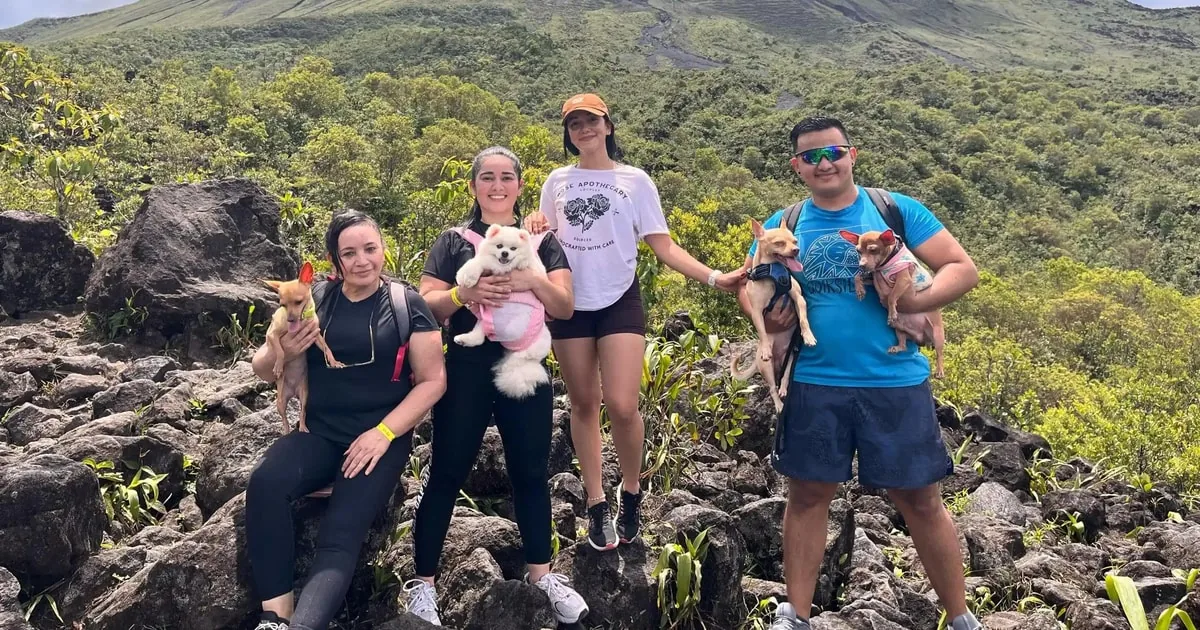 Park entry
La Fortuna: Arenal Volcano Ecological Park Entry Ticket
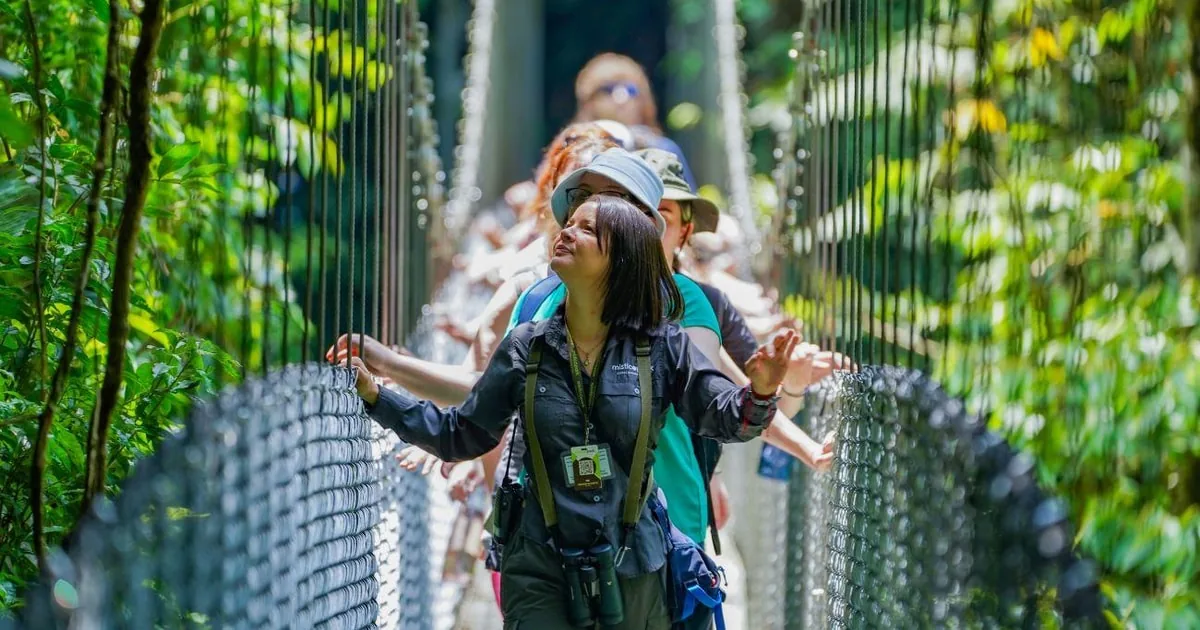 Canopy walk
La Fortuna: Místico Arenal Hanging Bridges Admission Ticket
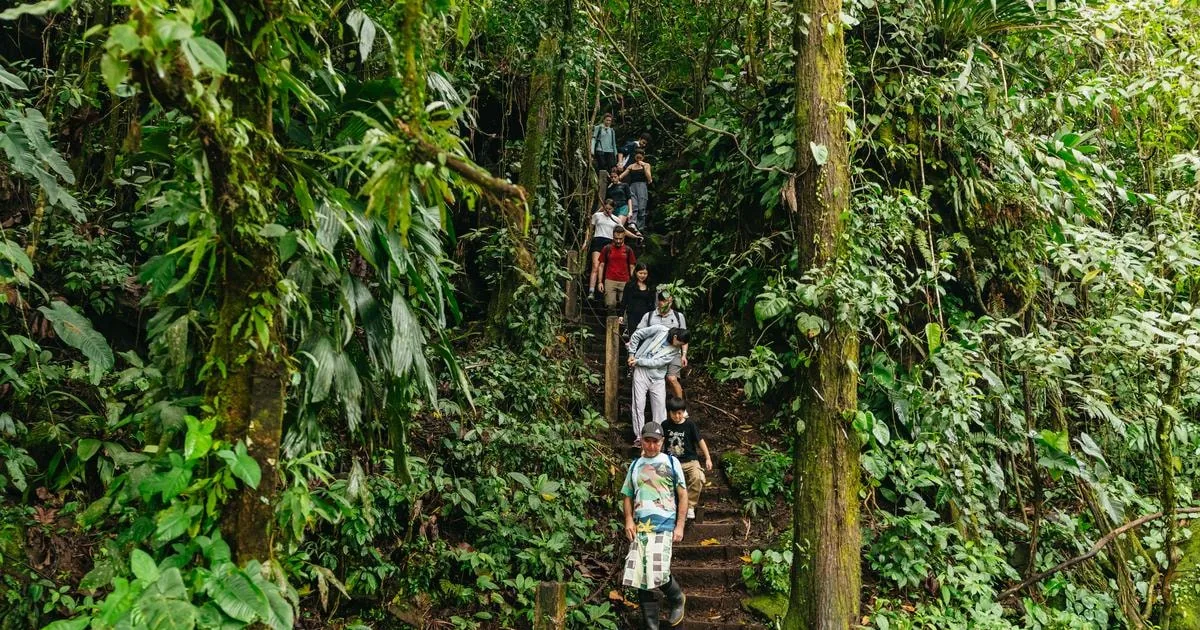 Most booked
La Fortuna: Waterfall, Arenal Volcano and Hot Springs Tour
Compare all eight tours, or read what a full day at the volcano actually looks like.
Frequently asked questions
Can you hike to the top of Arenal Volcano?
No. There is no legal route to the summit and no permit available to the public. A 4 km exclusion zone around the crater has been in force since 1998, and the upper cone is restricted to monitoring and emergency personnel.
Is it illegal to climb Arenal Volcano?
Yes. The upper cone sits inside a restricted exclusion zone administered by SINAC, Costa Rica's national conservation-areas authority, and Costa Rica has been increasing penalties for unauthorised entry into national park areas.
Can you still hike Cerro Chato?
No. SINAC closed it in February 2017 and ran barbed wire across the improvised trails; the closure was still in force in 2025. Enforcement is patchy and some people hike it anyway, but it is not permitted and no legitimate operator sells it. Older guides and forum posts still recommend it, which is why visitors keep arriving expecting to.
What is the Arenal volcano hike then?
A walk across the lava fields at the base, principally the 1992 flow on the Las Coladas trail and the 1968 flow in the adjacent private reserve. Elevation gain is minimal; the difficulty is the sharp, uneven volcanic rock underfoot.
How high is Arenal Volcano?
1,633 metres. Some sources give slightly higher figures, which is unsurprising for a cone that was actively rebuilding itself through 42 years of eruption, but 1,633 m is the most widely used and the one we use here.
Do guided tours take you up the volcano?
No legitimate operator does, because no legitimate operator can. Tours take you across the lava fields and to viewpoints on the lower flanks. If an operator offers a summit ascent, they are offering an illegal trip.