The Arenal Volcano hike: what you are actually doing
The biggest misconception
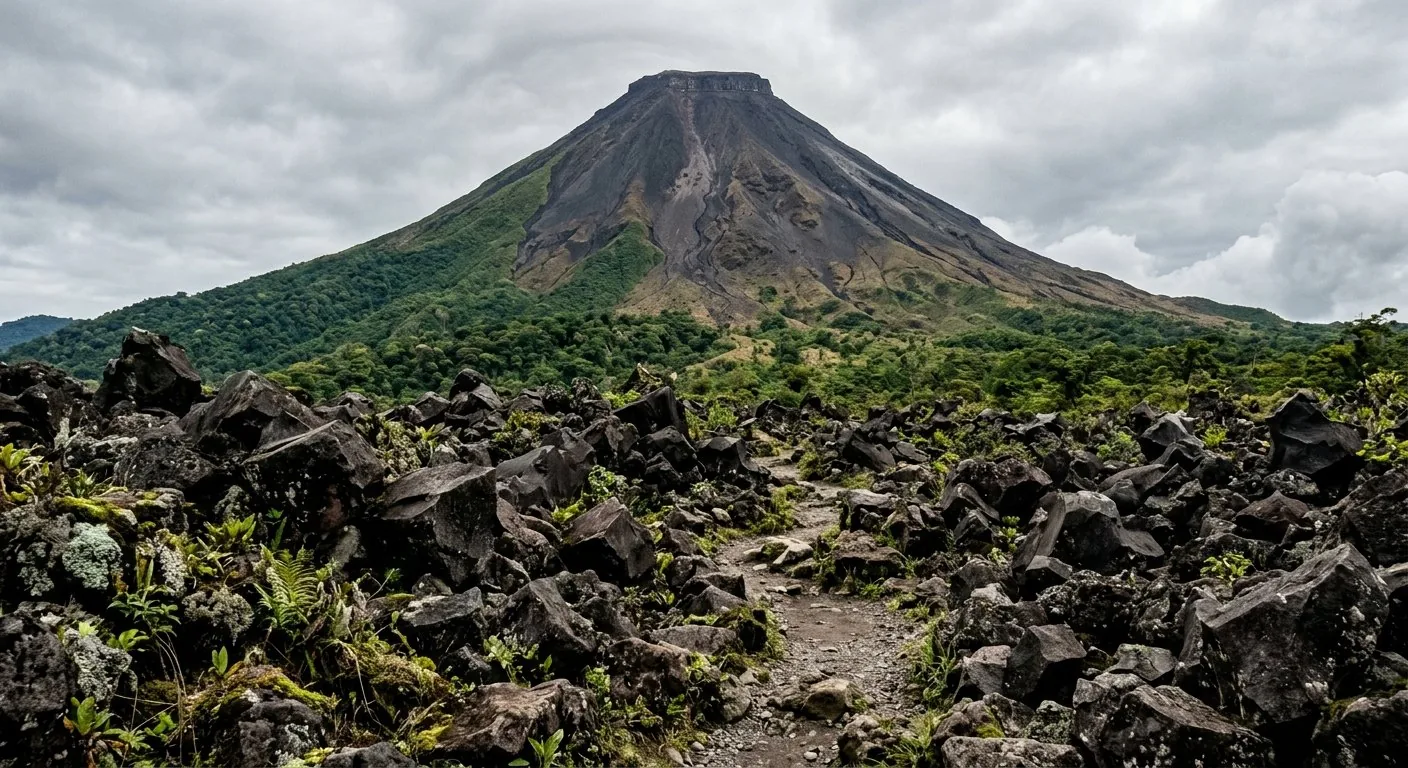
Most visitors assume "the Arenal hike" means climbing the cone — an ascent to the summit. It does not. There is no legal route to the summit, and a 4 km exclusion zone around the crater has been in force since 1998. What tours call the hike is a guided walk across the lava fields that erupted in 1968 and 1992. You start at the base, walk on cooled black rock for an hour or two, and return. You will be nowhere near the summit. Read why the cone is permanently closed.
What the 1968 lava field actually is
On 29 July 1968, Arenal erupted catastrophically after roughly 400 years of dormancy. The explosion killed 87 people, buried the villages of Tabacón, Pueblo Nuevo and San Luis, and ejected lava and ash across the region. The lava flow that hardened that day is what tourists walk on now. It is a landscape of black basalt, fractured and porous, textured by the way lava cools. In 15+ years of dormancy, sparse vegetation has begun to colonise the rock: lichen, hardy shrubs, occasional trees. Guides explain how lava flows, why the rock fractures in hexagons, and how ecosystems recover on barren ground.
What the hike feels like
The terrain is uneven. Barefoot travel is not possible; proper hiking boots are essential because the rock is sharp. The trail is marked, but you are stepping carefully from rock to rock rather than walking a smooth path. Most people find the first 20 minutes tiring as they adjust to the uneven ground; then the body settles in. The hike is not steep — you are walking on the base of the lava field, not climbing the cone — so the difficulty is footwork, not cardio.
The 1992 flow and cone views
A second lava field, from an eruption in 1992, sits adjacent to the 1968 flow. Some tours include both. The 1992 rock is sharper and less vegetated than the older 1968 flow. From the lava fields, if the cone is visible (it often is not due to cloud cover), you can see the perfectly symmetrical peak rising directly above. Cloud cover odds vary by month; early morning typically offers the best visibility.
How difficult is it?
Moderate. You need to be able to step carefully on uneven ground for 1.5 to 2.5 hours. The terrain is not steep, but it is not smooth. Older or less fit visitors can manage it with a guide’s pace and rest stops, but it is not a casual stroll. People with serious knee or ankle issues may find the uneven rock challenging.
Why this matters
Understanding what you are actually doing helps set expectations. You are not summiting. You are not experiencing an active eruption zone. You are walking on historical lava, learning geology from a guide, and (if lucky) seeing the cone. That is genuinely worthwhile. But it is not the adventure many visitors imagine.
Book a lava-field hike
Arenal Volcano Ecological Park entry includes access to the lava fields. Most tours add a guide, transportation and extra activities.
Frequently asked questions
Is the Arenal hike a summit attempt?
No. There is no legal route to the summit. What tours call the Arenal hike is a walk on the 1968 and 1992 lava fields at the base. You will not gain significant elevation.
What footwear do I need?
Sturdy hiking boots with ankle support are essential. The lava rock is sharp and uneven. Trainers or sandals will damage your feet. See the full packing guide.
How long does the hike take?
Most lava-field walks last 1.5 to 2.5 hours, depending on group pace and photo stops. Full-day tours including transportation, waterfall or wildlife add 4–6 hours total.